
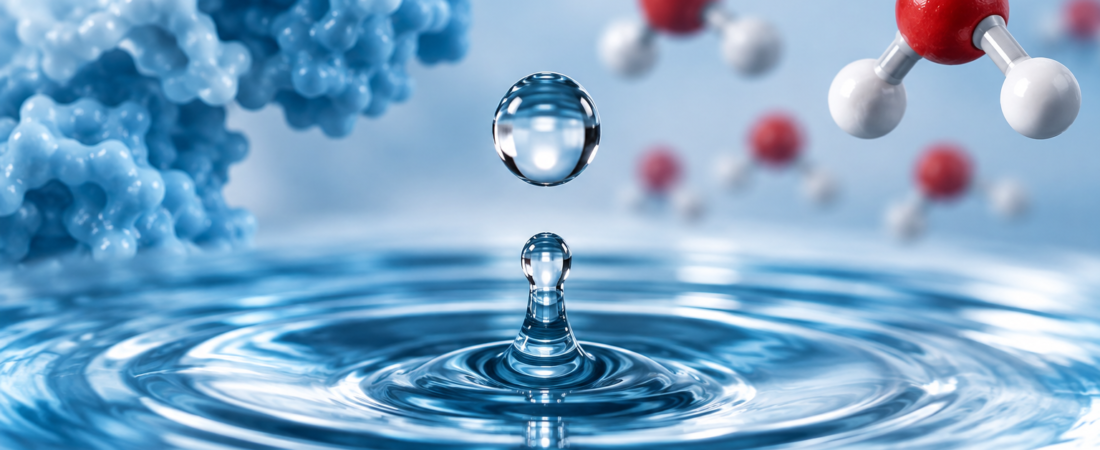
When I introduce water in biochemistry, students sometimes seem surprised by how much time we spend on such a familiar molecule. After all, water looks simple: two hydrogen atoms bonded to one oxygen atom.
But in biochemistry, water is never just background.
Its polarity, hydrogen bonding, and interactions with other molecules help explain why proteins fold, why membranes form, why pH matters, and why so many biological reactions behave the way they do.
If you understand water well, many later topics in biochemistry become much easier to make sense of.
Here are five reasons water matters so much in biochemistry.
1. Water Is Polar
The oxygen and hydrogen atoms in a water molecule do not share electrons equally. Oxygen attracts the shared electrons more strongly, giving oxygen a partial negative charge and the hydrogens partial positive charges.
This makes water a polar molecule.
That polarity allows water to interact effectively with ions and other polar molecules. When sodium chloride dissolves, for example, water molecules surround the separated Na⁺ and Cl⁻ ions and help stabilize them in solution.
This ability is one reason water is such an effective solvent for many substances found in biological systems.
One thing I encourage students to notice here is that “water is a good solvent” is not simply a fact to memorize. Its behavior as a solvent follows directly from its molecular structure. Once you make that connection, the chemistry becomes much easier to reason through.
2. Water Molecules Form Hydrogen Bonds
The partial charges on water molecules allow neighboring molecules to form hydrogen bonds with one another.
A single hydrogen bond is relatively weak compared with a covalent bond. But biological systems contain enormous numbers of them, and together they can have important effects.
Hydrogen bonding contributes to several familiar properties of water, including its relatively high boiling point, surface tension, and ability to absorb substantial heat before its temperature changes dramatically.
Hydrogen bonds are also important beyond water itself. They contribute to the structures and interactions of proteins, DNA, and many other biological molecules.
This is an important theme in biochemistry: an interaction does not have to be individually strong to be biologically important. Large numbers of relatively weak interactions can collectively have a major effect.
3. Water Helps Drive the Hydrophobic Effect
What happens when a nonpolar molecule is placed in water?
Water cannot interact favorably with the nonpolar molecule in the same way that it interacts with ions or polar groups. Water molecules instead become more ordered around the nonpolar surface.
When nonpolar groups cluster together, less nonpolar surface is exposed to water. Some of those ordered water molecules are released and can move more freely.
This is part of the hydrophobic effect.
The hydrophobic effect is extremely important in biochemistry. It contributes to processes such as the formation of cell membranes and the folding of proteins.
This is one of the places where I encourage students to move beyond the common statement that nonpolar molecules simply “hate water.” That description can be useful as a quick memory aid, but it misses an important part of the chemistry.
The surrounding water matters.
When nonpolar groups cluster, the increased freedom of some of the surrounding water molecules contributes to the thermodynamic favorability of that process. Thinking about the entire system, not just the nonpolar molecules, gives you a much better picture of what is happening.
4. Water Participates in Chemical Reactions
Water is not always just the solvent.
It can also be a reactant or product.
In hydrolysis reactions, water is used to break a covalent bond. In condensation reactions, also called dehydration reactions in many biological contexts, water can be produced as larger molecules form from smaller components.
These types of reactions appear throughout biochemistry, including in the chemistry of carbohydrates, proteins, lipids, and nucleic acids.
So when you see H₂O in a biochemical equation, do not automatically treat it as background. Ask whether water is actually participating in the reaction.
That simple question. “What role is water playing here?”, can be surprisingly useful when you are trying to understand a biochemical reaction rather than simply memorize it.
5. Water Is Closely Connected to pH
A small fraction of water molecules undergo ionization. A simplified representation is:
H₂O ⇌ H⁺ + OH⁻
In aqueous solution, however, a proton does not exist as an isolated H⁺. It associates with water molecules, and we commonly represent this using the hydronium ion, H₃O⁺:
2H₂O ⇌ H₃O⁺ + OH⁻
This equilibrium provides the foundation for understanding pH, acids, bases, and buffers.
And pH matters enormously in biology.
Changes in hydrogen ion concentration can affect the ionization states, charges, and interactions of biological molecules. For proteins in particular, changes in pH can influence structure, binding, and enzyme activity.
This is why biological systems need mechanisms for maintaining pH within appropriate ranges.
As you move into buffers and biological pH, try not to see them as completely new topics. They are extensions of the same chemistry of water and molecular interactions that you have already been learning.
Water Is Part of the Chemistry, Not Just the Background
As you move deeper into biochemistry, water keeps returning.
Protein folding? Water matters.
Cell membranes? Water matters.
Acid–base chemistry? Water matters.
Molecular interactions? Water matters.
That is why I think it is worth spending time understanding this seemingly simple molecule at the beginning of biochemistry.
If you understand water early, many later topics become easier because you begin to see that biological molecules do not behave in isolation. They are constantly interacting with their chemical environment.
The next time you encounter a biochemical process, try asking one additional question:
What is the water doing?
Sometimes that question reveals more about the chemistry than you might expect.