
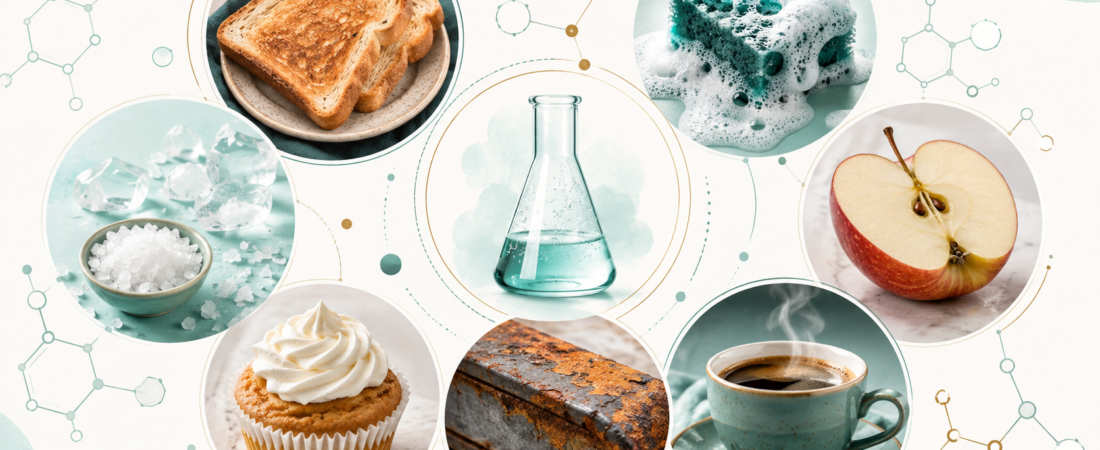
Chemistry is often introduced through equations, molecular structures, laboratory glassware, and carefully controlled experiments. But chemistry does not begin when we walk into a laboratory. It is already happening around us.
It is in the browning of bread, the cleaning power of soap, the smell of coffee, the tarnishing of metal, and even the reason salt changes the behavior of ice.
Once we begin to recognize these connections, chemistry becomes less like an abstract subject and more like a language for understanding everyday life.
Here are seven familiar examples.
1. Why Toast Turns Brown
A slice of bread placed in a toaster undergoes much more than simple drying.
As the surface becomes hot, amino acids and reducing sugars in the bread participate in a collection of reactions known as the Maillard reaction. These reactions produce many new compounds responsible for the brown color, aroma, and complex flavor of toasted foods.
The Maillard reaction is also responsible for some of the characteristic flavors and colors of roasted coffee, baked bread crust, grilled meat, and many other cooked foods.
This is different from caramelization, which primarily involves the thermal decomposition and transformation of sugars.
So the next time toast emerges golden brown from the toaster, what you are seeing is evidence of a surprisingly complicated network of chemical reactions.
2. Why Soap Removes Grease When Water Cannot
Anyone who has tried rinsing an oily pan with water knows that water alone is not particularly effective at removing grease.
The reason is molecular.
Water molecules are polar, while many oils and greases are largely nonpolar. Substances with very different polarity do not interact favorably, which is why oil tends to separate from water instead of dissolving in it.
Soap molecules solve this problem because they have two chemically different regions.
One portion interacts well with water, while another interacts well with oils and grease. In water, soap molecules can surround oily material and form structures called micelles. The grease becomes trapped within these assemblies and can then be carried away during rinsing.
Soap therefore acts as a molecular bridge between materials that would otherwise prefer to remain separate.
This familiar household process is an elegant example of intermolecular forces, polarity, and molecular structure working together.
3. Why Salt Helps Melt Ice
During winter, salt is commonly spread on icy roads and sidewalks.
Salt does not simply “heat up” the ice. Instead, when it dissolves in liquid water at the surface of the ice, the dissolved ions interfere with the normal freezing process.
The presence of dissolved particles lowers the freezing point of the solution. This phenomenon is called freezing-point depression.
Pure water freezes at approximately 0 °C under ordinary atmospheric pressure, but saltwater must reach a lower temperature before it freezes.
That is why adding salt can help melt ice when environmental conditions are appropriate.
The same principle belongs to a broader group of effects called colligative properties, in which the number of dissolved particles influences certain physical properties of a solution.
A bag of road salt is therefore an everyday application of solution chemistry.
4. Why Cut Apples Turn Brown
Slice an apple and leave it exposed to air, and the freshly cut surface gradually becomes brown.
This is not simply the fruit “getting old.” It is chemistry assisted by enzymes.
Cutting damages the apple’s cells and allows compounds that were previously separated inside the tissue to interact. Enzymes known as polyphenol oxidases help promote oxidation reactions involving naturally occurring phenolic compounds.
The resulting products undergo further reactions that eventually produce brown-colored pigments.
This also explains why certain treatments slow browning.
Lemon juice, for example, creates a more acidic environment and supplies compounds such as ascorbic acid that can interfere with the oxidation process.
A simple fruit salad therefore provides a useful demonstration of oxidation, enzymes, reaction conditions, and food chemistry.
5. Why Baking Soda Makes Cakes Rise
Many baked foods depend on a gas-producing chemical reaction.
Baking soda is sodium bicarbonate. When it encounters an appropriate acid in a recipe, an acid-base reaction occurs and carbon dioxide gas is produced.
The gas forms bubbles within the batter or dough. During baking, these gas pockets expand and contribute to the light, porous structure of the final product.
Baking powder works on a related principle but generally contains both a bicarbonate source and acidic components, allowing the necessary chemistry to occur without relying entirely on acidic ingredients already present in the recipe.
The texture of a cake can therefore depend on reaction stoichiometry, gas formation, temperature, and the physical structure of the batter.
Kitchen chemistry is real chemistry.
The equipment simply looks different.
6. Why Iron Rusts
Leave unprotected iron exposed to water and oxygen long enough and rust eventually appears.
Rusting is an electrochemical oxidation-reduction process.
Iron atoms lose electrons as they are oxidized. Oxygen participates in reduction reactions, and in the presence of water a series of subsequent processes eventually produces hydrated iron oxides commonly recognized as rust.
Water is especially important because it helps create the environment through which ions can move.
Salt can accelerate corrosion because dissolved ions increase the electrical conductivity of the water present on the metal surface. This is one reason vehicles and metal structures may experience significant corrosion in areas where roads are frequently treated with salt.
Rusting shows that oxidation-reduction chemistry is not restricted to a laboratory exercise involving half-reactions. It affects bridges, cars, tools, pipelines, buildings, and enormous amounts of infrastructure.
7. Why Coffee Smells So Different From Coffee Beans
Coffee aroma is not produced by a single molecule.
Roasting transforms the chemical composition of coffee beans through numerous reactions, producing a complex mixture of volatile compounds. Because these molecules can enter the gas phase, they travel through the air and eventually reach receptors in the nose.
Our perception of “coffee smell” is therefore the combined result of many different molecules interacting with our sensory system.
Temperature matters too. Warmer coffee generally releases volatile compounds more readily than cold coffee, which contributes to the intensity of its aroma.
What we casually describe as a pleasant smell is therefore connected to organic chemistry, volatility, intermolecular forces, thermal energy, and biology.
Chemistry Is Already Around Us
One of the most useful ways to understand chemistry is to stop thinking of it as something confined to a laboratory.
Everyday life is full of molecular interactions, energy changes, equilibria, oxidation-reduction reactions, acid-base chemistry, and changes in matter.
The kitchen is a chemical environment.
So is the bathroom.
So is the atmosphere.
So is a winter road covered with salt.
Recognizing the chemistry around us does more than make ordinary experiences interesting. It helps us understand why materials behave the way they do, why familiar processes work, and how scientific principles connect to decisions we make every day.
Sometimes the most interesting chemistry is not hidden in an experiment.
It is hiding in plain sight.