
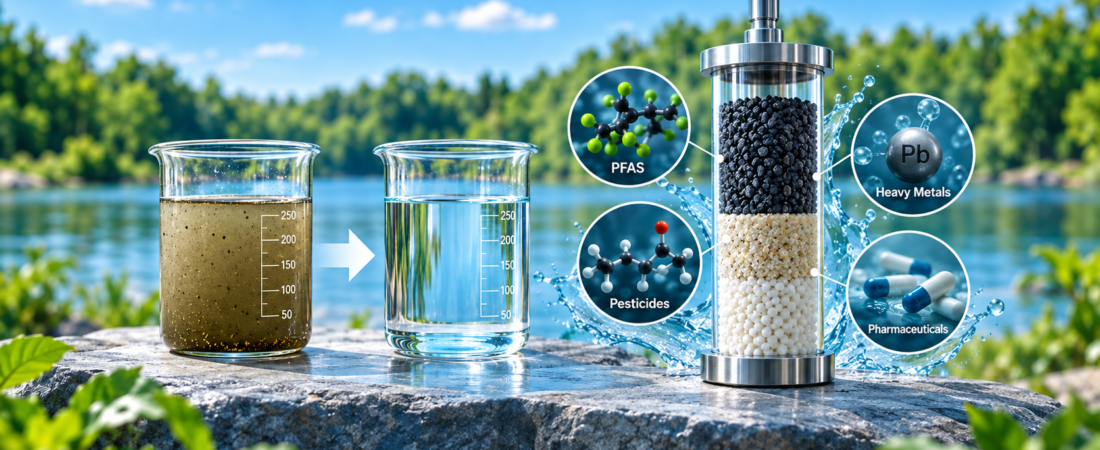
Clean water can look deceptively simple.
One of the things I find most interesting about environmental chemistry is that a glass of water can look perfectly clear while still containing dissolved chemicals that cannot be seen, smelled, or easily removed.
When we talk about water pollution, it is tempting to imagine treatment as a kind of filtering process: contaminated water goes in, clean water comes out.
In reality, the chemistry is much more complicated.
Some contaminants can be removed relatively easily. Others are surprisingly persistent.
Why?
The answer is largely chemistry.
A pollutant’s molecular structure, charge, solubility, concentration, stability, and interactions with other substances all influence how difficult it is to remove. Water treatment is therefore not simply a matter of filtering out unwanted material. The treatment method has to match the chemistry of the contaminant.
Here are some of the reasons certain pollutants are much harder to remove than others.
1. Some Pollutants Dissolve Extremely Well in Water
Think about sand in water.
If you mix sand into a glass of water and allow it to sit, much of the sand eventually settles. A physical filter can also capture the particles relatively easily.
Now think about salt.
Once salt dissolves, you can no longer remove it with an ordinary filter. The sodium and chloride ions are dispersed throughout the water at the molecular level.
Many pollutants behave more like the salt than the sand.
Once dissolved, their molecules or ions can pass through treatment systems designed mainly to remove suspended particles.
This is one reason water treatment often requires several different steps. Removing visible particles and removing dissolved contaminants are two very different chemical challenges.
2. Molecular Structure Matters
The structure of a pollutant influences almost everything about how it behaves in water.
Some molecules interact strongly with water. Others interact more readily with organic matter, sediments, or surfaces. Some contain chemical bonds that are relatively easy to break, while others are remarkably resistant to degradation.
This means two pollutants present at similar concentrations may require completely different treatment strategies.
Activated carbon, for example, can be effective for contaminants that readily adsorb onto carbon surfaces. Other compounds may not interact strongly enough with the carbon to be removed efficiently.
Membrane technologies can separate many dissolved contaminants, but their effectiveness depends on properties such as molecular size, charge, and the type of membrane being used.
There is rarely one treatment method that works equally well for every chemical.
3. Extremely Stable Molecules Are Difficult to Destroy
Removing a contaminant from water and destroying it are not necessarily the same thing.
This distinction is easy to overlook.
Some treatment methods simply transfer the contaminant somewhere else.
Activated carbon may capture a pollutant from water, for example, but the pollutant is now associated with the carbon. A membrane may produce cleaner water while concentrating contaminants in another stream.
Other treatment methods attempt to chemically transform pollutants into less harmful substances.
The difficulty is that some molecules are highly stable. Their chemical bonds may resist biological degradation, sunlight, oxidation, or other processes that would normally break chemicals down.
Persistent organic pollutants, or POPs, are an important example. Their persistence is one reason researchers continue to investigate treatment technologies capable of degrading these compounds rather than simply moving them from water into another material.
This is an area closely connected to my own work. In a recent review, my coauthor and I examined bismuth-based photocatalysts for the degradation of persistent organic pollutants and discussed their potential, as well as some of the challenges that remain before photocatalytic technologies can be applied more broadly in real environmental systems.
4. Very Low Concentrations Can Still Be Difficult to Treat
It might seem logical that a very small amount of pollution should be easier to remove.
Sometimes the opposite is true.
Environmental contaminants may occur at extremely low concentrations and still matter because of toxicity, persistence, or concerns about long-term exposure.
Imagine trying to find and remove a few grains of a particular substance from an enormous container.
The lower the concentration becomes, the more sensitive our analytical methods must be to detect it. Treatment systems may also need to reduce an already tiny concentration even further.
Environmental chemists commonly work with concentrations expressed in milligrams per liter, micrograms per liter, and sometimes even nanograms per liter.
At these concentrations, both measurement and treatment can become technically demanding.
Detecting a pollutant is one challenge. Removing enough of it to meet a treatment goal can be another.
5. Pollutants Can Change Form Depending on Water Chemistry
A chemical does not always remain in exactly the same form once it enters water.
Conditions such as pH can influence whether certain compounds are neutral or charged. Metals may form complexes with other substances. Some contaminants can attach to suspended particles or organic matter, while others may undergo chemical or biological reactions and transform into different compounds.
These changes matter because different forms of the same contaminant can behave very differently during treatment.
A charged compound, for example, may interact strongly with an ion-exchange material, while a neutral form of the same compound may behave differently.
This is one of the questions environmental chemists have to consider carefully.
Knowing how much of a contaminant is present is important, but it is not always enough.
We also need to ask:
What chemical form is it in?
That question can completely change how we approach treatment.
6. Real Water Contains Much More Than the Pollutant
Laboratory experiments sometimes begin with purified water containing one contaminant.
Real environmental water is far more complicated.
Groundwater, surface water, and wastewater may contain dissolved minerals, natural organic matter, microorganisms, suspended particles, salts, nutrients, and many other organic and inorganic compounds.
All of these substances can influence treatment.
For example, natural organic matter may occupy adsorption sites that could otherwise capture a target contaminant. Other dissolved substances may react with oxidants intended to attack the pollutant.
This is something environmental chemists have to think about constantly. A treatment process that works beautifully in a controlled laboratory solution may behave very differently in real water.
The surrounding water chemistry matters.
7. Some Pollutants Do Not Stay in the Water
Pollution does not remain neatly dissolved in water.
Many contaminants can interact with soil, sediment, organic matter, or suspended particles.
At first, this may sound helpful. If the pollutant leaves the water, perhaps the problem has disappeared.
Unfortunately, it may only have moved.
Sediments and soils can sometimes act as reservoirs for contaminants. Changes in environmental conditions may allow previously retained chemicals to enter the water again.
A pollutant can therefore move between different parts of an environmental system over time.
This is one reason environmental cleanup often requires looking beyond the water itself. Water, sediment, soil, microorganisms, and surrounding ecosystems may all be part of the same chemical problem.
So How Do We Remove Difficult Pollutants?
There is no universal treatment method.
The best approach depends on the chemistry of the contaminant and the water in which it is found.
Adsorption can capture certain contaminants on the surfaces of materials such as activated carbon. Ion exchange can target charged substances. Membrane technologies can separate contaminants based on properties such as size and charge. Biological treatment uses microorganisms to break down biodegradable compounds, while chemical oxidation uses reactive species to transform pollutants.
Another approach is photocatalysis.
Often, the most effective treatment system combines more than one method. One stage might remove suspended material, while another targets dissolved contaminants.
Each stage solves a different part of the chemistry problem.
Where Photocatalysis Comes In
Photocatalysis is one treatment approach I find particularly interesting because it aims to do more than simply capture a pollutant.
A photocatalyst absorbs light and helps drive chemical reactions that can break down contaminant molecules. Depending on the system, reactive species can be generated that attack the pollutant and transform it into smaller products.
Much of my own research has focused on developing and studying light-activated, bismuth-based photocatalytic materials for degrading difficult organic contaminants in water.
One example is glyphosate.
In one of our studies, we investigated the photocatalytic mineralization of glyphosate using Pd@BiVO₄/BiOBr nanosheets. We did not simply measure whether glyphosate disappeared. We also examined the degradation products and investigated the pathways through which the molecule was broken down.
That distinction is important.
When evaluating a treatment technology, it is not enough to know that the concentration of the original pollutant decreased. We also want to understand what happened to the molecule after treatment.
That leads to another important question.
Removal Is Not Always the Same as Destruction
If a treatment process removes a pollutant from water but concentrates it somewhere else, the contaminant may still need to be managed.
For example, spent activated carbon, concentrated membrane waste, or contaminated treatment materials cannot simply be ignored.
A treatment process should therefore be evaluated not only by asking:
Did the pollutant disappear from the water?
We also need to ask:
Where did it go?
And if the pollutant was chemically transformed:
What did it become?
These questions are especially important when treatment produces transformation products that may have their own chemical and environmental properties.
The Bigger Lesson: Water Treatment Is a Chemistry Problem
When we say that water is “treated,” it can sound as though every unwanted chemical simply passes through the same purification process.
In reality, every contaminant presents its own chemical puzzle.
Is the pollutant dissolved or attached to particles?
Is it charged?
Will it adsorb onto a surface?
Can microorganisms break it down?
Can a chemical reaction transform it?
Will treatment simply move it somewhere else?
Could the treatment process create other compounds that also need to be considered?
Those questions help determine which treatment strategy is most likely to work.
This is one of the reasons I find environmental chemistry so fascinating. Water treatment is not simply about removing something unwanted. It is about understanding the chemistry of a contaminant well enough to determine how we might remove, transform, or control it.
In other words, every contaminant presents its own chemistry problem.
And solving that problem begins with understanding the chemistry.
Related Research
If you would like to explore some of the research connected to the topics discussed here, these two publications are particularly relevant.
Bismuth-based photocatalysts for the degradation of persistent organic pollutants (POPs)
Gbemisola J. Bamiduro and Elsayed M. Zahran, Journal of Environmental Chemical Engineering (2025).
Rapid photocatalytic mineralization of glyphosate by Pd@BiVO₄/BiOBr nanosheets: Mechanistic studies and degradation pathways
Gbemisola J. Bamiduro, Caitlyn M. Dollar, Sarah Abaddi, Nicholas Ensinger, and Elsayed M. Zahran, Catalysis Communications (2023).