
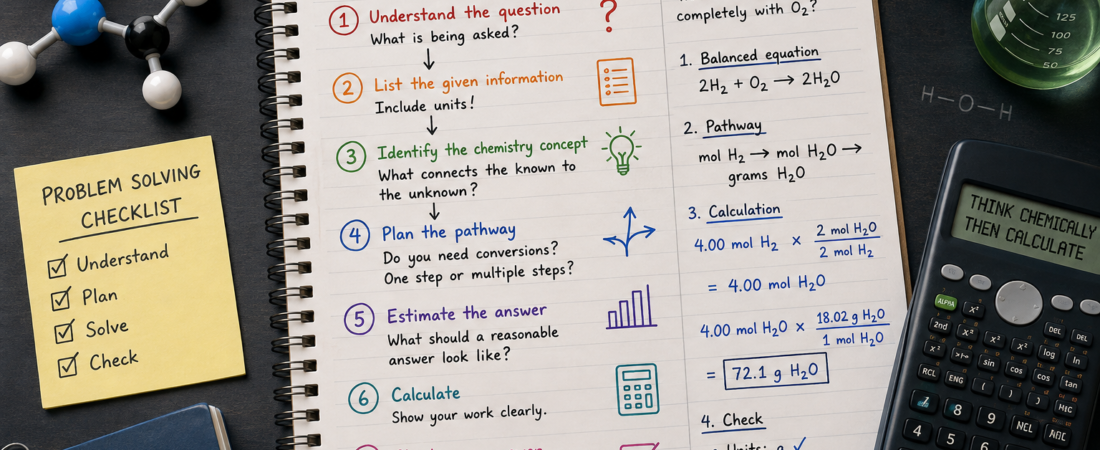
One of the most common mistakes students make in chemistry happens before they ever touch a calculator.
They see numbers in a problem, search their notes for an equation that contains those numbers, plug everything in, and hope the answer looks reasonable.
Sometimes that works.
Often, it does not.
Chemistry problems become much easier when you first figure out what the problem is really asking you to do. The calculation should come near the end of your thinking process, not at the beginning.
Here is a simple approach you can use for many chemistry problems.
1. Read the Question Before Looking for an Equation
Before calculating anything, ask:
What am I being asked to find?
It sounds obvious, but students often start manipulating numbers before identifying the actual unknown.
Suppose a problem says:
A 25.0 mL sample of a solution contains 0.0150 mol of NaCl. What is the molarity of the solution?
Before doing anything else, identify:
Known:
Volume = 25.0 mL
Amount of NaCl = 0.0150 mol
Unknown:
Molarity
Now the problem has direction.
You are not simply looking for an equation involving 25.0 and 0.0150. You are trying to determine concentration from moles and volume.
That distinction matters.
2. Identify the Chemistry Concept
Once you know what the problem is asking, ask:
What chemistry idea connects the information I have to the information I need?
For the example above, the concept is molarity.
Now there is a reason to use the equation.
The equation follows from understanding the problem rather than replacing understanding.
This becomes even more important when problems contain extra information. Not every number given in a chemistry problem must necessarily be used.
3. Write Down the Given Information With Units
Always include units.
Instead of writing:
25.0
0.0150
write:
25.0 mL
0.0150 mol NaCl
Units often tell you what conversion is needed and can even help reveal which equation makes sense.
In our example, molarity requires liters, but the volume is given in milliliters.
So before calculating molarity, convert the volume:
Now the molarity setup becomes:
which gives:
or:
The units help guide the setup.
4. Ask Whether a Conversion Is Needed
Many chemistry problems are really a sequence of conversions.
Consider this question:
How many moles are present in 36.0 g of water?
You are given grams but asked for moles.
The connection between grams and moles is molar mass.
For water:
So the problem becomes:
The grams of water cancel, leaving moles of water.
That is exactly what we want.
If your units do not lead toward the unit requested in the question, stop and reconsider your setup before calculating.
5. Map the Path From What You Know to What You Need
This strategy becomes especially useful for multi-step problems.
Suppose you are asked:
How many grams of water are produced when 4.00 mol of hydrogen reacts completely with excess oxygen?
The balanced equation is:
Before calculating, map the pathway:
moles H₂ → moles H₂O → grams H₂O
Now each step has a purpose.
First, use the mole ratio from the balanced chemical equation:
Then convert moles of water to grams using its molar mass:
This gives:
Now the final unit is grams, exactly what the question requested.
The important part is not memorizing that particular calculation.
It is learning to recognize the pathway:
What do I have? → What intermediate quantity do I need? → What am I trying to find?
6. Estimate What a Reasonable Answer Should Look Like
Before pressing the calculator button, pause for a moment.
Ask:
Should the answer be large or small?
Should it be positive?
Should it be greater than or less than the starting quantity?
Consider a simple example.
If 1 mole of a substance has a mass of approximately 20 g, then 10 moles should have a mass somewhere around 200 g.
If your calculator gives you 0.002 g, something has probably gone wrong.
An estimate does not need to be precise. Its purpose is to give you a reference point for judging your final answer.
This habit can catch errors that a calculator cannot.
7. Calculate Only After the Setup Makes Sense
Once you have:
- identified the unknown,
- identified the chemistry concept,
- organized the known information,
- converted units if necessary, and
- established the pathway from known to unknown,
then calculate.
At this stage, the calculator is simply completing the arithmetic.
That is where it belongs.
A calculator can multiply and divide perfectly, but it cannot tell you whether you chose the correct chemical relationship.
8. Let the Units Help You
Units are one of the most useful problem-solving tools in chemistry.
Suppose you calculate density.
The relationship is:
If mass is measured in grams and volume is measured in milliliters, then the resulting unit should be:
If you are asked for density in g/mL and your calculation leaves you with something like mL/g or mol/L, that should immediately make you question your setup.
Units are not decorations added after the calculation.
They are part of the calculation.
This is one reason dimensional analysis is so powerful. When units cancel correctly, they provide evidence that your pathway may be reasonable.
They cannot guarantee that the chemistry is correct, but they can expose many common mistakes.
9. Check Whether the Answer Makes Chemical Sense
A mathematically correct calculation can still produce a chemically unreasonable answer if the setup was wrong.
Imagine calculating the percentage composition of a compound and obtaining:
Your arithmetic may have been performed correctly, but that answer cannot represent a valid mass percentage of one component of the compound.
Or suppose you are working with a strongly acidic aqueous solution and obtain a pH that appears strongly basic.
That should make you stop and examine your assumptions and calculations.
Chemistry provides context that helps you evaluate the result.
Ask yourself:
Does this answer fit what I know about the system?
10. Do Not Ignore Significant Figures
Once you have solved the chemistry correctly, consider how precisely the answer should be reported.
Suppose your calculator produces:
That does not necessarily mean your answer should contain all of those digits.
The precision of your final result depends on the measurements used in the calculation.
For multiplication and division, the final result is generally reported with the same number of significant figures as the measurement containing the fewest significant figures.
So if your starting quantity contains three significant figures, your final answer will often need three significant figures as well.
Do not let your calculator decide how many digits are meaningful.
A Simple Chemistry Problem-Solving Checklist
When you encounter a chemistry problem, try working through these questions in order:
1. What am I being asked to find?
2. What information has been given?
3. What chemistry concept connects the known information to the unknown?
4. Do any units need to be converted?
5. Is this a one-step problem or a multi-step pathway?
6. What should a reasonable answer roughly look like?
7. Do my units cancel correctly?
8. Does my final answer have the correct units?
9. Does the answer make chemical sense?
10. Have I reported the answer with appropriate significant figures?
You do not need to write every question out every time.
With practice, this way of thinking becomes automatic.
The Goal Is Not to Memorize More Equations
Students sometimes respond to difficult chemistry problems by trying to memorize even more formulas.
But many chemistry problems are difficult not because the necessary equation is unknown, but because it is unclear when and why to use it.
Strong chemistry problem solving comes from recognizing relationships.
Moles connect to mass through molar mass.
Moles of one substance connect to another through a balanced chemical equation.
Concentration connects moles to solution volume.
Gas variables connect through relationships involving pressure, volume, temperature, and amount.
Equilibrium, thermodynamics, kinetics, and acid-base chemistry each introduce additional relationships, but the underlying strategy remains remarkably similar.
Start with the chemistry.
Then do the mathematics.
Before You Reach for the Calculator
The next time you encounter a chemistry problem, resist the urge to immediately search for a formula.
Instead, pause and ask:
What do I know?
What do I need to know?
What chemistry connects the two?
Once you can answer those questions, the calculation often becomes the easiest part of the problem.
And that is one of the most important shifts students can make when learning chemistry: moving from plugging numbers into equations to actually thinking chemically.